


Moodswing - The Third Revolution In Psychiatry
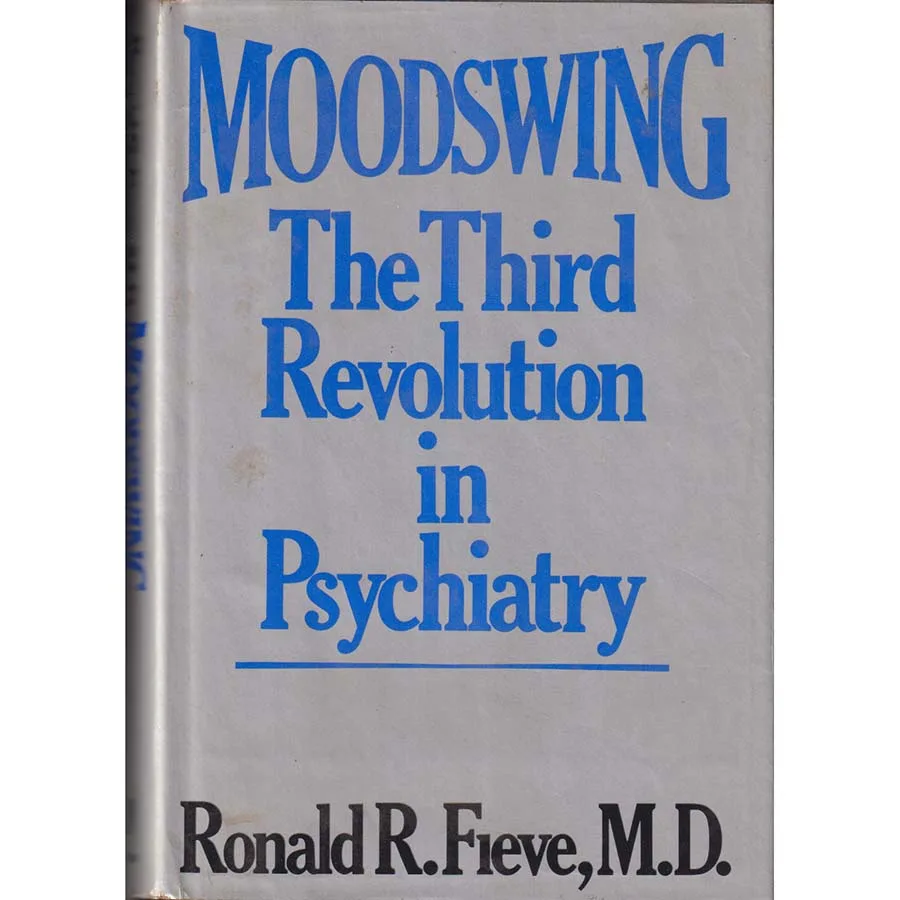
Publisher: Morrow
Format: Hardback
ISBN: 0688029388
In Moodswing, psychiatrist Ronald R. Fieve announces nothing less than “the third revolution in psychiatry,” which is a satisfyingly confident subtitle for a book published at a time when medicine still permitted revolutions to be declared by a single doctor in a jacket and tie. His subject is the biological treatment of severe mood disorders, particularly manic depression—now generally called bipolar disorder—and the then-transformative use of lithium carbonate.
Fieve was one of the American pioneers of lithium treatment and established an early specialist lithium clinic. Here he draws upon clinical experience and case histories to explain the cycles of mania and depression: the periods of extraordinary energy, confidence and activity that may be followed by incapacitating despair. To the outside observer, the elevated phase can initially resemble unusual productivity or enthusiasm. The difficulty is that enthusiasm may eventually begin purchasing three sports cars, founding a religion and telephoning the President before breakfast.
The book argues that mood disorders are not simply failures of character, insufficient willpower or obscure grievances waiting to be uncovered after several expensive years on a couch. Fieve places biological processes and drug treatment at the centre of the discussion. Lithium, an unassuming chemical element with none of the glamour expected of a psychiatric revolution, offered many patients the possibility of stabilising destructive extremes and preventing future episodes.
Moodswing also explores the complicated relationship between unstable moods and creativity. Artists, writers, leaders and unusually productive people may appear to derive energy from elevated states, raising the uncomfortable question of whether treatment will suppress the gifts along with the illness. Fieve considers prominent historical figures, including Abraham Lincoln, Theodore Roosevelt and Winston Churchill, through the lens of mood disorder—an exercise combining psychiatry, biography and the unavoidable difficulty that none of the patients can be invited in for assessment.
Alcohol and drugs also enter the discussion as forms of attempted self-treatment. People struggling with anxiety, agitation or depression may reach for whatever temporarily alters the feeling, only to acquire a second problem while failing to solve the first. The human nervous system, regrettably, is not always improved by allowing it to prescribe for itself.
Published in 1975, the book belongs to an important moment in the history of psychiatry. Psychoanalysis still occupied a powerful cultural position, but biological explanations and psychopharmacology were rapidly changing clinical practice. Moodswing helped bring discussions of manic depression and lithium out of specialist clinics and into ordinary homes, where families could begin to recognise patterns that had previously been treated as mysterious changes of personality or spectacular lapses in judgement.
Some of the terminology, claims and confidence inevitably reflect the medical thinking of the 1970s. Psychiatry has continued to develop, diagnostic language has changed and modern readers should not treat a fifty-year-old popular medical book as current personal treatment advice. It remains, however, a fascinating record of how a major change in understanding was presented while that change was still new enough to be called a revolution without embarrassment.
This 1975 Morrow edition is in Good condition. The spine is very slightly slanted, but the deviation is so modest that an expert—or someone who has brought measuring equipment to a second-hand book—would probably be required to notice it. Ordinary readers are unlikely to experience any disturbance whatsoever, and the text remains sound, complete and perfectly readable.
Indeed, a barely perceptible lean seems almost thematically appropriate for a book about departures from emotional equilibrium. The spine has shifted fractionally from the absolute centre but remains entirely functional, which may be the most restrained physical interpretation of the title that any copy could offer.
Ideal for readers interested in the history of psychiatry, bipolar disorder, lithium treatment, medical revolutions or the curious period when popular psychology books could discuss Churchill, creativity, biological clocks and chemical elements within the same soberly authoritative covers.
A Good copy sold by Crappy Old Books—historically significant, clinically confident and leaning so slightly that only a trained professional is likely to diagnose it.
Keep browsing: See more Academic books Other books by Ronald R Fieve
